






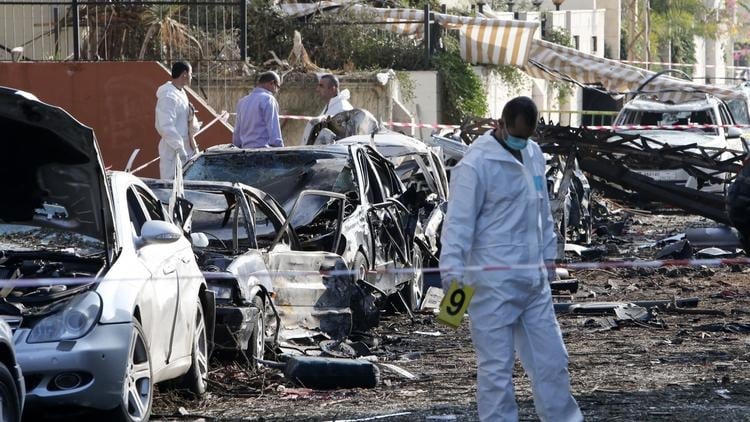
Forensic experts at the scene of the attack in front of the Iranian embassy in Jnah, southern Beirut, on Nov. 19, 2013. (Archive photo: AFP)






BEIRUT — More than twelve years after the events, the Court of Justice, headed by the president of the Court of Cassation and president of the Supreme Judicial Council (CSM), Souheil Abboud, held on Friday a first hearing in the two cases of the attacks carried out in Beirut against the Iranian embassy in Jnah (Nov. 19, 2013), and the Iranian cultural center in Bir Hassan (Feb. 19, 2014). Asked about the delay, a judicial source recalled that the members of the Court of Justice were only appointed in September 2025, at the end of a long vacancy period due to a blockage of judicial appointments. This was part of a context of institutional crisis and political tensions, which only began to resolve with the election of Joseph Aoun to the presidency in January 2025.
In the meantime, the two cases followed their judicial course. The examining magistrate in charge of these cases completed his investigations, then issued his indictments, after obtaining the opinion of the Office of the Attorney General at the Court of Cassation.
Carried out through suicide operations, the two attacks respectively caused 24 deaths and 150 injuries, and six deaths and 120 injuries. They took place in the context of the war in Syria, which pitted the regime of ousted President Bashar al-Assad against rebel groups, against a backdrop of Tehran and Hezbollah support for Damascus. A Sunni Islamist group linked to al-Qaida, the Abdallah Azzam Brigades, claimed responsibility for the two attacks, portraying them as retaliation for Iranian support for the Assad regime and demanding the withdrawal of Hezbollah fighters from Syria.
Next hearing on Nov. 27
At the start of Friday's hearing, the Court of Justice decided to merge the two cases because of their close connection, given the involvement of the same defendants and the similarity of the modus operandi of the attacks.
Twenty-five defendants are being prosecuted in this context, nine of whom are in detention. According to the previously mentioned judicial source, they are of Lebanese, Palestinian, and Syrian nationality. They allegedly played different roles in the preparation and execution of the attacks: some allegedly transported the car bombs, others transported the suicide bombers, while still others allegedly provided the explosives or placed them in the vehicles.

 1 p.m. recap: Hezbollah offers extensive aid package for the displaced; ICRC warns of 'disaster' in Middle East; explosive device found in the Bekaa